How I use AI in 2026
August 4, 2026
When it comes to AI use, I see a lot of commentary about how these tools will either bring about end-times or provide overabundance and ease. There’s not much written about what people are using AI for in their day-to-day lives and the practical use cases they’ve found.
I left the corporate workplace at a super weird time for the tech industry. When I started working on my own in January 2025, most AI tools for programming were pretty nascent, and involved copy-pasting code in and out of ChatGPT. Beyond the UX inefficiencies, the models themselves didn’t read from the Internet and it made working with fast-moving tech changes clunky to use. Mere months later, tools like Claude Code became ubiquitous, and you could suddenly work like a bulldozer, rather than a scalpel, on large codebases.
I use AI tooling every day to build Table Slayer, Counter Slayer, and this site. Given the rapid pace of advancement, I thought it might be useful to document how I use AI at this particular time (August 2026) for both code and personal use. My assumption is that this post will feel just as dated as my previous posts on this subject in another year or two.
- The models I use
- I use AI to build complex web apps
- I use AI to troubleshoot my Linux workstation
- I use AI to research my media hobbies
- I use AI to learn the mechanics of board games
- I use AI to create quick TTRPG encounters
- I use AI for tip of my tongue searches
- I use AI for copywriting
- I don’t use AI to create artwork
- I don’t use AI for social needs, and don’t share personal information
- What I’m worried about with AI
The models I use
I generally use the latest model from Anthropic available on their max subscription tier. Right now that’s Fable, which, at least for code tasks, seems like a pretty large jump over previous models. Outside some occasional explorations into esoteric models for other tasks, I’m pretty happy in the Claude ecosystem and haven’t found a reason to change.
I use AI to build complex web apps
I primarily use Claude Code in a terminal, jumping to Neovim when I need to review or make manual edits. My projects are open source, and I don’t really hide my AI use in those repos. They all come with claude.md files that give some instructions for how to work within the repo, and I’ve started to build repo-specific skills to form patterns and prime Claude for the overall architecture of the projects. The latter has really helped avoid AI footguns and provides historical context for architecture decisions.
Both “Slayer” sites are high-complexity web apps, and Table Slayer in particular has a multitude of hard problems: “3D” canvases, post-processing, networked multiplayer, and game-level browser performance tuning. I add the usual web architecture niceties: a mono-repo, custom design system, auth system, billing, PR previews off of prod data with GitHub workflows…etc. I try to avoid dependencies, and outside some core platform choices (Svelte, Turso, Partykit, Cloudflare, yJS) I try to have the code live in the repos. I’m pretty happy with the stability and code quality of the apps I build. I feel I prune and rework as much as I did when I was the primary writer of the code.
Despite handing off most code duties, I’ve learned more about web technologies in the last two years than I likely did in the previous ten. Two years ago I was a UX designer who was an expert in CSS, with a healthy amount of experience in React component systems and the usual smattering of web worker skills (git, vim, Linux…etc). In the past two years, with the help of Claude, I now understand quite a bit about the following subjects:
- Database modeling, migrations and performance
- JavaScript API patterns and architecture
- Auth systems and general cryptography patterns
- Three JS capabilities and limits
- Webhooks, workers, and crons
- Websockets and complex state passthru
- Docker setups and generalized web hosting
- Region-level hosting with embedded replicas
- Billing systems and subscriptions
I admittedly came into this period of AI discovery with a lot of prior knowledge (nearly 20 years in the industry with multiple successful startups), but the level of acceleration in my raw skills feels absolutely baffling to me. In eighteen months I’ve graduated into a makeshift full-stack engineer. That I learned this much at age 46 and not 26 sort of blows my mind.
In some ways I feel AI tools like Claude Code are a perfect fit for people like me. I’ve always known what I wanted to build, and always struggled with how to build it. I tend to excel at learning through exploration and reverse-engineering rather than coursework. Claude Code is the perfect tutor for me. It doesn’t judge my dumb questions, and I feel comfortable going off on tangents to understand a subject before applying it.
Learning while I code
A good example of this study was working through a problem I had a few months ago: trying to get Table Slayer’s fog of war syncs to be faster. Previously, the fog of war was a stored black and white image per map that was used as a mask for the 3D “clouds” to mimic. This required a round-trip upload / download from my media server and an update in the DB. Aside from the 2-second lag this caused, I had to add lots of cache busting on the images themselves, because I didn’t want to store a new image every time the fog changed.
I was smart enough to recognize the problem, but I didn’t really know a better way to solve it. I could blob the images and store URIs? But that would be a lot to store in my DB. I started bugging Claude about other options. I’d previously moved to an embedded SQLite database to make my DB operations fast, but the image round trip was always going to be slow on the network.
Claude suggested storing run-length encoding data in the database directly. Essentially, rather than store physical images, or blobs, we could store a shorter string made of the “runs” of white and black pixels. A 6x2 image of 4 black pixels, followed by 2 white ones and 6 more black, can become 4B 2W 6B. Here’s what it looks like in practice.

446485W 19B 1880W 59B 1849W 80B 1830W 98B 1814W 112B 1801W 124B 1789W 136B 1779W 145B 1770W 154B 1761W 162B 1754W 170B 1746W 177B 1739W 184B 1732W 191B 1726W 196B 1721W 202B 1714W 208B 1709W 214B 1703W 219B 1698W 224B 1693W 229B 1688W 234B 1684W 238B 1679W 243B 1674W 248B 1670W 252B 1665W 256B 1662W 260B 1657W 265B 1653W 268B 1649W 273B 1645W 277B 1640W 281B 1637W 285B 1633W 288B 1629W 292B 1626W 296B 1622W 299B 1618W 303B 1615W 307B 1611W 310B 1608W 313B 1605W 316B 1601W 321B 1597W 324B 1594W 327B 1591W 330B 1588W 333B 1585W 336B 1582W 339B 1578W 343B 1575W 346B 1572W 349B 1569W 352B 1566W 355B 1563W 358B 1560W 361B 1557W 364B 1554W 367B 1551W 370B 1548W 373B 1545W 376B 1542W 379B 1539W 381B 1537W 384B 1534W 387B 1531W 390B 1528W 393B 1525W 396B 1522W 398B 1520W 401B 1517W 404B 1514W 406B 1512W 409B 1509W 412B 1506W 415B 1503W 417B 1501W 420B 1498W 423B 1495W 425B 1493W 428B 1490W 430B 1488W 433B 1485W 436B 1482W 438B 1480W 441B 1477W 443B 1475W 446B 1472W 448B 1470W 451B 1467W 454B 1464W 456B 1463W 458B 1460W 460B 1458W 463B 1455W 465B 1453W 468B 1450W 470B 1448W 473B 1445W 475B 1443W 477B 1441W 480B 1438W 482B 1436W 485B 1433W 487B 1432W 489B 1429W 491B 1427W 493B 1425W 496B 1422W 498B 1420W 501B 1417W 503B 1415W 505B 1413W 508B 1410W 510B 1409W 511B 1407W 514B 1404W 516B 1402W 518B 1400W 521B 1397W 523B 1395W 525B 1393W 528B 1390W 530B 1388W 532B 1387W 534B 1384W 536B 1382W 538B 1380W 540B 1378W 543B 1375W 545B 1373W 547B 1371W 549B 1369W 552B 1367W 553B 1365W 555B 1363W 557B 1361W 560B 1358W 562B 1356W 564B 1354W 566B 1352W 568B 1350W 571B 1348W 572B 1346W 574B 1344W 576B 1342W 578B 1340W 581B 1337W 583B 1335W 585B 1333W 587B 1332W 588B 1330W 590B 1328W 592B 1326W 595B 1323W 597B 1321W 599B 1319W 601B 1317W 603B 1316W 604B 1314W 606B 1312W 608B 1310W 610B 1308W 613B 1305W 615B 1303W 617B 1302W 618B 1300W 620B 1298W 622B 1296W 624B 1294W 626B 1292W 628B 1290W 630B 1288W 632B 1287W 633B 1285W 635B 1283W 638B 1280W 640B 1278W 642B 1276W 644B 1274W 646B 1273W 647B 1271W 649B 1269W 651B 1267W 653B 1265W 655B 1263W 657B 1261W 659B 1260W 660B 1258W 662B 1256W 664B 1254W 666B 1252W 668B 1250W 670B 1248W 672B 1246W 674B 1245W 675B 1243W 677B 1241W 679B 1239W 681B 1237W 683B 1235W 685B 1233W 687B 1232W 688B 1230W 691B 1227W 693B 1225W 695B 1223W 697B 1221W 699B 1219W 701B 1217W 703B 1216W 704B 1214W 706B 1212W 708B 1210W 710B 1208W 712B 127W 21B 1058W 714B 117W 41B 1046W 716B 110W 54B 1038W 718B 104W 65B 1031W 720B 99W 75B 1025W 721B 93W 85B 1019W 723B 88W 93B 1014W 725B 82W 102B 1009W 727B 76W 111B 1004W 729B 70W 120B 999W 731B 64W 129B 994W 733B 58W 137B 990W 735B 52W 146B 985W 737B 46W 154B 981W 739B 40W 162B 977W 741B 34W 170B 974W 742B 27W 179B 970W 744B 21W 187B 965W 747B 15W 195B 961W 749B 9W 203B 957W 751B 2W 211B 954W 968B 950W 972B 946W 975B 943W 979B 940W 981B 937W 985B 933W 988B 931W 991B 927W 994B 925W 997B 921W 1000B 919W 1002B 916W 1005B 914W 1008B 911W 1010B 908W 1013B 906W 1015B 904W 1017B 902W 1019B 899W 1023B 896W 1025B 894W 1027B 892W 1029B 890W 1031B 888W 1033B 886W 1035B 884W 1037B 882W 1039B 880W 1041B 878W 1043B 876W 1045B 874W 1047B 872W 1049B 870W 1051B 868W 1052B 867W 1054B 865W 1056B 863W 1058B 862W 1059B 860W 1061B 858W 1062B 857W 1064B 855W 1066B 854W 1067B 852W 1069B 850W 1070B 849W 1072B 848W 1073B 846W 1075B 844W 1076B 844W 1077B 842W 1079B 840W 1081B 839W 1081B 838W 1083B 836W 1085B 835W 1085B 834W 1087B 833W 1087B 832W 1089B 830W 1091B 829W 1091B 828W 1093B 827W 1094B 825W 1095B 825W 1096B 823W 1097B 823W 1098B 821W 1100B 820W 1100B 819W 1102B 818W 1102B 817W 1104B 816W 1105B 814W 1106B 814W 1107B 813W 1107B 812W 1109B 811W 1109B 810W 1111B 809W 1111B 809W 1112B 807W 1114B 806W 1114B 806W 1115B 804W 1116B 804W 1117B 802W 1118B 802W 1119B 801W 1119B 801W 1120B 799W 1121B 799W 1122B 798W 1123B 796W 1124B 796W 1125B 795W 1125B 795W 1126B 793W 1128B 792W 1129B 791W 1130B 790W 1131B 788W 529B 1W 603B 787W 527B 3W 604B 786W 525B 5W 605B 785W 523B 7W 606B 784W 522B 8W 607B 782W 521B 10W 608B 781W 519B 12W 609B 780W 517B 14W 610B 779W 515B 16W 611B 778W 513B 18W 612B 777W 511B 20W 613B 775W 510B 22W 614B 774W 508B 24W 615B 773W 506B 26W 616B 772W 504B 28W 617B 771W 502B 30W 618B 770W 500B 32W 619B 769W 498B 34W 620B 768W 496B 36W 621B 767W 494B 38W 622B 766W 492B 40W 623B 764W 491B 42W 624B 763W 489B 44W 625B 762W 487B 46W 626B 761W 486B 47W 627B 760W 484B 49W 628B 759W 482B 51W 629B 758W 480B 53W 630B 757W 478B 55W 631B 756W 476B 57W 632B 755W 474B 59W 633B 754W 472B 61W 634B 753W 470B 63W 635B 752W 468B 65W 636B 751W 466B 67W 636B 751W 464B 69W 637B 750W 463B 70W 638B 749W 461B 72W 639B 748W 459B 74W 640B 747W 457B 76W 641B 746W 455B 78W 642B 745W 453B 80W 642B 745W 451B 82W 643B 744W 449B 84W 644B 744W 446B 86W 645B 743W 444B 88W 646B 742W 443B 89W 646B 742W 441B 91W 647B 741W 439B 93W 648B 740W 437B 95W 649B 739W 435B 97W 649B 739W 433B 99W 650B 738W 431B 101W 651B 738W 428B 103W 652B 737W 426B 105W 652B 737W 424B 107W 653B 736W 423B 108W 654B 735W 421B 110W 654B 735W 419B 112W 655B 735W 416B 114W 655B 735W 414B 116W 656B 734W 412B 118W 657B 733W 410B 120W 657B 733W 408B 122W 658B 733W 406B 123W 658B 733W 404B 125W 659B 732W 402B 128W 659B 731W 400B 130W 659B 731W 398B 132W 660B 731W 395B 134W 660B 731W 393B 136W 661B 730W 391B 138W 661B 731W 388B 140W 662B 730W 387B 141W 662B 730W 385B 143W 663B 729W 383B 145W 663B 730W 380B 148W 663B 729W 378B 150W 663B 729W 376B 152W 664B 729W 373B 154W 664B 729W 371B 156W 665B 728W 370B 157W 665B 729W 367B 159W 666B 728W 365B 162W 665B 729W 362B 164W 666B 728W 360B 166W 666B 728W 358B 168W 667B 728W 355B 170W 667B 728W 354B 171W 668B 728W 351B 174W 667B 728W 349B 176W 667B 728W 347B 178W 668B 728W 344B 180W 668B 728W 342B 182W 669B 728W 339B 185W 668B 728W 337B 187W 668B 729W 335B 188W 669B 728W 333B 190W 669B 729W 330B 193W 669B 728W 328B 195W 669B 729W 325B 197W 669B 729W 323B 199W 670B 729W 320B 202W 669B 729W 319B 203W 669B 730W 316B 205W 670B 729W 314B 208W 669B 730W 311B 210W 669B 730W 309B 212W 669B 731W 306B 215W 669B 731W 303B 217W 669B 731W 301B 219W 669B 732W 299B 221W 669B 731W 297B 223W 669B 732W 294B 225W 669B 733W 291B 228W 668B 733W 289B 230W 669B 733W 286B 232W 669B 734W 283B 235W 668B 734W 282B 236W 668B 735W 279B 239W 667B 736W 276B 241W 668B 736W 273B 243W 668B 736W 271B 246W 667B 737W 268B 248W 667B 738W 265B 251W 666B 739W 262B 253W 666B 739W 261B 255W 666B 739W 258B 257W 666B 740W 255B 260W 665B 741W 252B 262W 665B 742W 249B 264W 665B 743W 246B 267W 664B 743W 244B 269W 664B 744W 242B 271W 663B 745W 239B 274W 662B 746W 236B 276W 663B 746W 233B 279W 662B 747W 230B 281W 662B 748W 227B 284W 661B 749W 224B 286W 661B 750W 221B 289W 660B 751W 219B 290W 660B 752W 216B 293W 659B 753W 213B 296W 658B 754W 210B 298W 658B 756W 206B 301W 657B 757W 203B 304W 656B 758W 200B 306W 656B 759W 197B 309W 655B 760W 194B 311W 655B 762W 191B 313W 654B 763W 188B 316W 653B 764W 185B 319W 652B 766W 181B 321W 652B 767W 178B 324W 651B 769W 174B 327W 650B 770W 171B 330W 649B 772W 167B 332W 649B 773W 164B 335W 648B 775W 160B 338W 647B 776W 157B 341W 646B 778W 153B 344W 644B 781W 149B 346W 644B 782W 146B 349W 643B 784W 142B 352W 642B 786W 138B 355W 641B 788W 134B 358W 640B 790W 130B 361W 639B 792W 126B 364W 638B 795W 121B 367W 637B 797W 116B 371W 635B 800W 112B 374W 634B 803W 106B 378W 633B 806W 100B 382W 632B 809W 95B 385W 631B 812W 88B 390W 630B 815W 82B 394W 628B 820W 74B 399W 627B 824W 66B 404W 626B 829W 56B 410W 625B 835W 44B 417W 624B 843W 28B 427W 621B 1300W 620B 1301W 619B 1302W 618B 1304W 615B 1306W 614B 1307W 613B 1309W 611B 1310W 609B 1313W 607B 1314W 295B 4W 307B 1316W 286B 12W 305B 1318W 279B 19W 304B 1320W 271B 26W 303B 1322W 262B 34W 301B 1324W 255B 41W 300B 1326W 247B 48W 299B 1328W 238B 56W 297B 1331W 230B 63W 296B 1333W 221B 71W 295B 1335W 213B 78W 293B 1338W 204B 86W 292B 1340W 196B 93W 290B 1343W 187B 101W 289B 1346W 177B 109W 288B 1348W 169B 116W 286B 1352W 159B 124W 285B 1355W 149B 132W 283B 1359W 139B 140W 282B 1362W 129B 148W 281B 1365W 119B 156W 279B 1370W 107B 165W 278B 1374W 96B 173W 276B 1380W 83B 182W 275B 1385W 69B 192W 273B 1393W 52B 203W 272B 1403W 29B 217W 270B 1651W 269B 1652W 267B 1654W 266B 1655W 264B 1657W 262B 1659W 261B 1660W 259B 1662W 258B 1663W 256B 1665W 254B 1666W 254B 1667W 252B 1669W 251B 1669W 250B 1671W 248B 1673W 247B 1673W 246B 1675W 244B 1677W 242B 1679W 241B 1679W 240B 1681W 238B 1683W 236B 1685W 235B 1685W 234B 1687W 232B 1689W 230B 1691W 228B 1693W 226B 1695W 225B 1695W 224B 1697W 222B 1699W 220B 1701W 218B 1703W 216B 1705W 214B 1707W 212B 1709W 210B 1711W 208B 1713W 206B 1715W 204B 1717W 202B 1720W 199B 1722W 196B 1725W 194B 1727W 192B 1729W 190B 1731W 188B 1734W 184B 1737W 182B 1739W 180B 1742W 176B 1745W 174B 1748W 170B 1751W 168B 1754W 165B 1756W 162B 1760W 158B 1763W 156B 1766W 152B 1770W 148B 1774W 145B 1776W 142B 1780W 138B 1784W 134B 1788W 130B 1793W 125B 1797W 121B 1801W 116B 1807W 111B 1811W 106B 1817W 100B 1823W 95B 1828W 88B 1835W 82B 1842W 74B 1850W 66B 1859W 56B 1870W 44B 1884W 28B 407462W
The original mask is 1920x1080 and, despite being a black and white image, would generally be around 120kb in size. When we transfer that information instead to a run-length encoded string, we get something like the example beside it, which is bytes in size. The latter, converted to base64, provides a level of compression that is easy to send over the wire in JSON across Partykit and store directly in my DB for quick retrieval.
“RLE” was a new concept to me. I came into computers organically at home; I didn’t learn this stuff, and I work primarily on my own. I just knew my problem, and was smart enough to know what type of solution wouldn’t work. It suggested plenty of other solutions before coming to this one. I had to be active enough in the decisions to research and validate the concepts proposed. I can tell you that I tried to solve “make Table Slayer faster” several times in multiple PRs before eventually figuring out this specific bottleneck. For me, I was happy to learn about it through this method.
My overall point is that I know what run-length encoding is now. I can guarantee I wouldn’t have known about it without AI exploration, and moreover, I never would have taken on a complicated project like this in the first place if I didn’t have AI tooling to support me. Yes, I use AI to do the grunt work of coding, but I use it primarily every day to accelerate my own learning; the code is just a byproduct.
I don’t let AI make commits
Call me old-fashioned, but I don’t like Claude creating or signing the commits to my repos. Likely, my own pride is in the way here, but I also spend so much time cleaning up its initial ideas and code that at best its a shared credit. I still make branches, make commits, push the files, test things manually and then verify the PRs and review them there. I always look over the code to make sure I understand it, and spend most of my time trying to get AI to follow my own preferences in code-style than anything else.
I’ve read quite a bit about people who are more lenient than me, and let their agents run overnight without breaks. That’s not me. I watch the stream in real-time and stop it occasionally when I see it doing something I don’t like. I don’t give it access to my DBs, don’t let it run SQL and don’t let it generate or run migrations of any kind, even on dev databases.
I have a feeling this is the line of mine that move the most over the next coming years. Eventually the code itself won’t matter and I’ll give in.
I use AI to troubleshoot my Linux workstation
I’ve written before about how “I’m a Linux” and made the transition to Linux workstations many years before AI came around. I’m comfortable in pretty bare-bones systems, and even made a fairly popular getting started video series for folks to help them transition to distros like Arch. That said, I don’t know everything, and often it’s a lot easier to query AI about how certain systems work, or feed it some logs to troubleshoot.
I’m more conservative than most here. I mostly do traditional question-and-answer chats for this and feed it information, or give it targeted access to certain logs while we diagnose. It’s rare that I give AI access to system level files.
I also use AI to manage my Neovim config and Tinty theming. I used to dread major Neovim bumps because it was hard to keep up with the various Treesitter and theme changes. Now it’s fairly easy to talk directly with Claude and tell it the issues I’m seeing, feed it a couple logs, or let it run in headless mode to get Neovim running the way I prefer.
Lastly, I’ve used AI to write dozens of small scripts to convert data between systems or run command line tools. This past year I converted my DVD and music libraries to be accessible from my NAS over Plex. Rather than install bulky tools that would only be used once, I put together small workflows to automate a lot of these tasks. It also helped to create backup solutions and run health checks along the way.
Trying to remember ffmpeg commands

I use AI to research my media hobbies
The most surprising usage of AI for me is that I have a pretty long-running chat going about art-house and independent cinema. I feed Claude a lot of my movie likes and dislikes and try to wrestle out recommendations for movies that I wouldn’t have known about. I used to run a few movie websites, so there’s not a lot I’ve missed, and I’m pretty picky about what I watch.
Finding indie flicks I might have missed
Over the past year I’ve gotten some great recommendations out of AI. Although some of these films saw some manner of award coverage originally, for the most part I lost track of them for one reason or another. Conversations with AI gave me great pointers to check them out.
- The Hit (1984)
- Leave No Trace (2018)
- Wendy and Lucy (2008)
- Thunder Road (2018)
- The Rider (2017)
- Shotgun Stories (2007)
- Mikey and Nicky (1976)
- Mississippi Grind (2015)
If anything, I found AI’s knowledge of indie cinema pretty awesome. While it’s easy to get impressed by Claude Code blazing away in my repos, it’s just as impressive to have the entire corpus of film criticism at hand for a quick chat. This means that if I want to have a conversation about Pauline Kael and Cassavetes movies in the 70s it’s totally game. This is the closest I ever get to AI filling a void in my social life. Despite my wife being a film minor, and having several friends who are deep into movies, I don’t have anyone to bounce against when talking about micro-niches and eras of the movie industry. Definitely not at 2:30am.
When I was in my twenties I remember using editorial recommendation databases like AllMusic to do this kind of “similar to” and “inspired by” research, but AI tooling has made it immensely faster and more specific. I really like AI for this, and even without all the code tooling I use it for, I would likely pay just for this service alone.
I use AI to learn the mechanics of board games
Over the last year I’ve fallen in deep with board games as my primary recreational hobby. I usually pick up a new game a month, and while part of the fun is learning new game mechanics, I’m not someone who likes poring over rule books. Typically, I learn by watching a few playthroughs on YouTube, then load PDF versions of the rules into a new Claude project so that I can query the rules as I play. This use case is the only one where I actually like to use a microphone to perform most of my queries. I can play the game and just randomly ask questions as I run into issues.
Clarifying rules for Star Trek Captain's Chair
I use AI to create quick TTRPG encounters
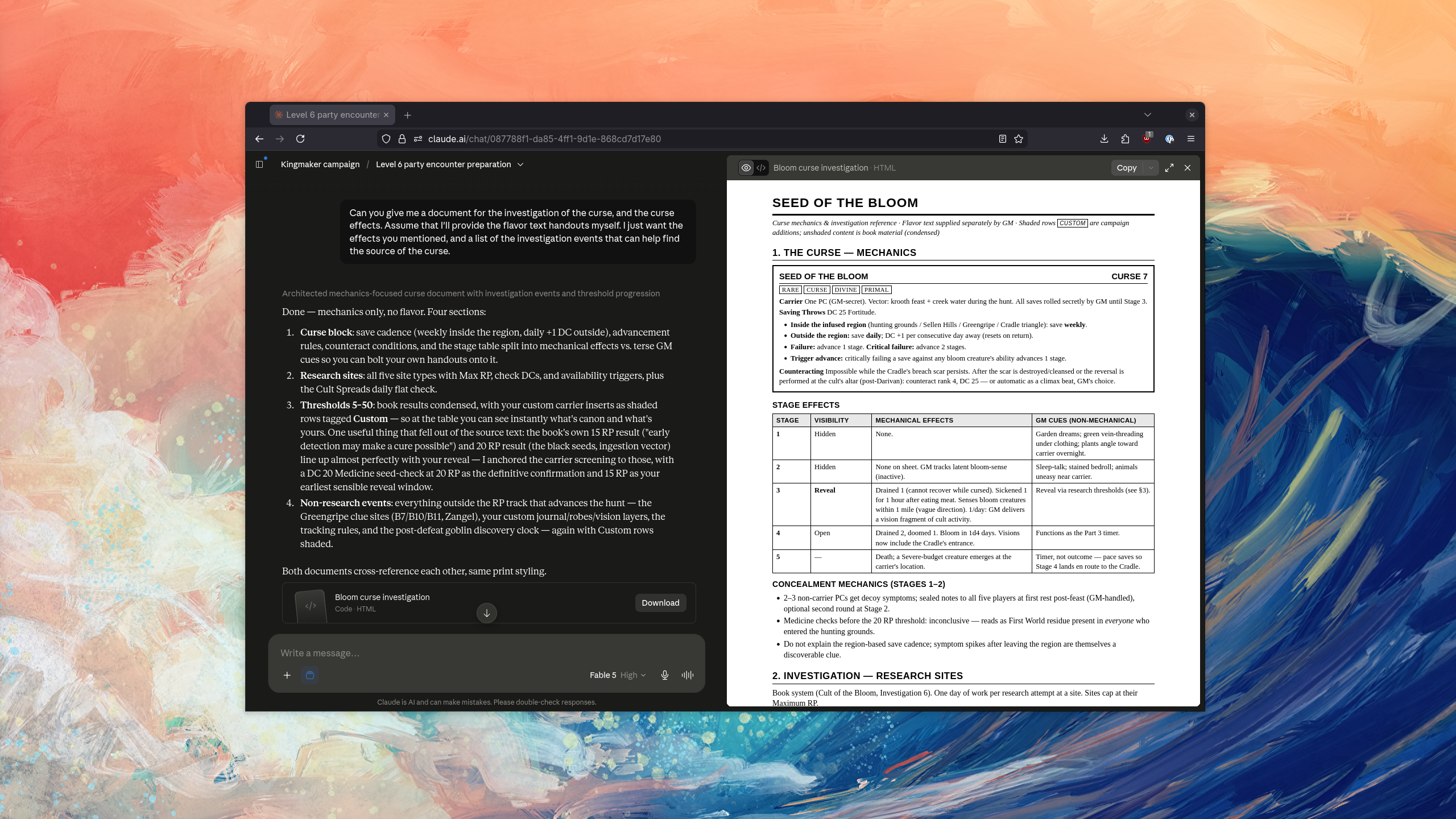
I DM two games currently. One is a Pathfinder 2E Kingmaker campaign, and the other is a DND Phandelver campaign. It’s a lot of work, and can sometimes be a bear to manage when my players go off the rails. Like my board games, I will often upload the source books for my campaigns into Claude so that I can query specifics (monster stats, NPC names…etc) on the fly while we play. More interesting is that during prep I’ll often build custom encounters for the next game. Typically I already have the encounter figured out and just want stat blocks and some game mechanics to match whatever I come up with.
What AI is most helpful for here is generating printable documents that I can use as reference sheets during my game. Running a game is mostly about improv and I don’t use these sheets literally. Mostly I just have them as a general outline of events that can happen, and then freeform build off them during the game. Below is an example of building a slightly skewed encounter from source material.
I use AI for tip of my tongue searches
As I get older my memory sometimes fails me and I’ll forget the name of a movie or book I read. I can remember plot points or actors, but not the name of the movie itself. This type of searching is fantastic for LLMs, which can usually figure these things out quickly when I give them enough information.
Hunting for a movie title
I use AI for copywriting
Although I have no problems using AI to write code, I never use it to write blog posts or emails. Though I spent a lot of time building up skills as a programmer, the output of those skills was always the product itself. With writing, the output is the writing. I’ve similar spent years developing my voice and don’t want that augmented.
I do make tons of errors, and want to avoid them. Typically, I’ll run a blog post like this through AI tooling to fix grammatical errors. Hilariously, like John Scalzi I was always a fan of em dashes and semicolons, and chuckle every time someone mentions them as a “tell”.
I don’t use AI to create artwork
Table Slayer has a lot of illustrations, and I wanted to invoke the feeling of 1980s metal albums with its art. There was never a point where I thought “I’ll just use AI for that”. I knew immediately I wanted to work with an illustrator and would pay them appropriately for their time. Cinnamon Devil did all the fantastic work on the site, and it took months to get everything done. I love her art and even if an AI could create that sort of look I probably wouldn’t use it.
I’ve fooled around with Midjourney and other, local modals. Maybe they’ll improve eventually, but for now it all seems pretty fake.
I don’t use AI for social needs, and don’t share personal information
A couple years ago I remember suggesting to a coworker that it would be interesting to see each others chat logs, to see how we used it differently. They blushed and admitted quite frankly that they used AI to talk through personal quandaries and social interactions.
This woke me up to the idea that people use these tools very differently than me. I think this is why we all feel so differently about AI usage. For me, it’s just an input / output tool for work. For others, it helps them in places a therapist might. I have no judgements here, and part of my own blog posting and journaling is a mechanism to think through my own decisions. Chatbots in a way are no different. It’s the privacy that is concerning.
What I’m worried about with AI
I’m not an expert in global economics or energy consumption. My engineer’s mind mostly looks at AI as a new technology, and an advancement over a long line of tools built by humans (based on the work of other humans) to speed up work. I’m not qualified to talk beyond that, and my evaluations of AI are in the tool output, rather than the byproduct of the tool. Likely you have your own opinions, and this post isn’t meant to change them.
I’m not particularly worried about AI removing the joy of creation and craft. That may be a general, societal problem at large, but it’s not one for me in my personal use. If anything, I’ve gotten more creative and challenged myself more than at any other point in my career. I’m not looking for wholesale invention from these tools, but a work partner who can teach me as I go. Right now, it’s doing its job.
That said, AI has become useful enough to me personally that I’m worried about how it eventually gets limited or polluted. Because LLMs are summarization tools primarily, I’m worried about what source data gets summarized, and how I can tell the difference between something being weighted in one direction or the other. Using a dumb example from earlier in this post, I’m worried what movie recommendations I might get once a movie studio decides to pay to shift the weights in one direction or the other. What happens when a startup pays to have their solutions and skills built directly into these generalized tools?
I’m old enough to remember a more independent Internet, and the consolidation of content that came after. That wave largely destroyed whole industries; some, like journalism, never really recovered, creating a net negative for society. I have the same fears here, except that I’m worried that as we move more and more to summarized LLM content, the actual source information that powers it will get harder to get a hold of. Kept clean, these tools are amazing, but there’s plenty of historical precedent to understand that data pollution because of politics or monetary policy is coming.
I’m also mature enough, and have enough background education, to understand the pitfalls of these tools and what can happen if you use them to build things, rather than learn things as you go. Talk five minutes with any school teacher and you’ll understand the problem. It’s not the cheating that they’re worried about, it’s the abandonment of learning. How can you understand the importance of an education if you don’t build up enough personal brainpower to recognize its usefulness?
Privacy is a big problem I can’t avoid though. By using these tools I’m volunteering quite a bit about myself. Even when Claude pulls up a “memory” of a previous conversation I get a little creeped out. Yes, I’m that weird Linux guy working on Table Slayer that wants to have a sidebar about 1970s crime cinema. I’ve sent it pictures of my car to diagnose engine troubles, asked it about vacation spots, and generally shared a lot about myself. It’s concerning. Right now I share a lot about myself publicly already. My activity page is essentially a timeline of what I do all day, but it doesn’t capture everything, and I’m pretty specific about what I do share publicly and keep to myself.
I do worry about general access to these tools. Their ubiquity in daily life will be common, but if governments, companies and individuals have differing access to them, it will create a level of classism that will be scary. Right now the Internet and libraries provide nearly same access source material to us. Will AI models provide the same? Will they destroy source information as a way to collect knowledge?
What I know is that these tools aren’t going away. The wave has already broken, and we’ll need to be careful, both as creators and as consumers of these new tools. I remain optimistic overall, and despite the noise of the current era, think that humanity tends to reconcile towards goodness in the long term. Then again, I watch a lot of Star Trek, and was raised on The Muppets. What do I know?